

Coming soon
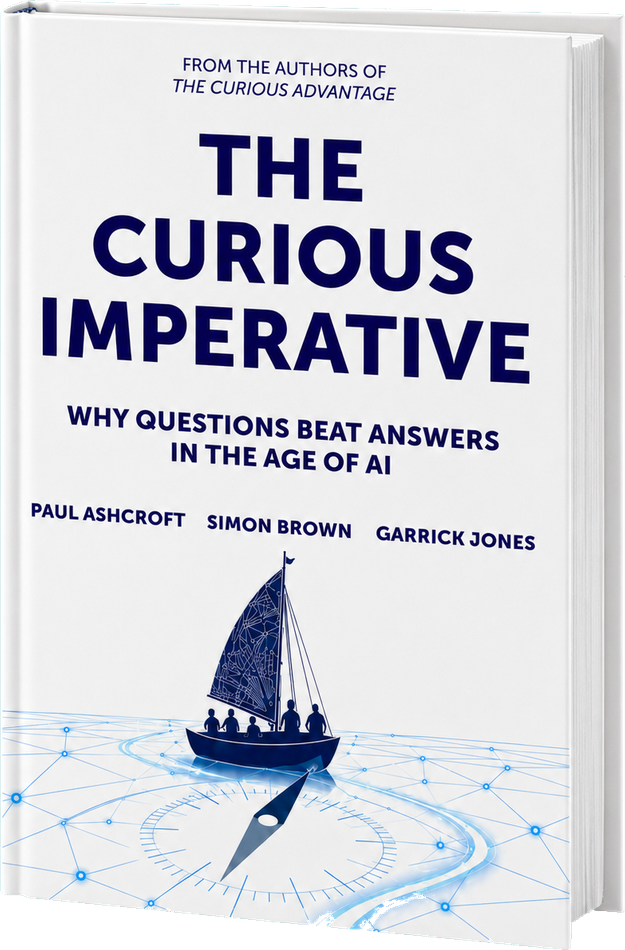
The Curious Imperative
Why questions matter more than answers in the age of AI
Paul Ashcroft · Simon Brown · Garrick Jones
What’s inside
Why has curiosity become an imperative?
- The five futures AI could produce — and a test for which one your budget is really funding.
- Sailing the 7 Cs of Curiosity, rebuilt for the AI age: what each C means now that answers are free.
- Curiosity debt — the capability that erodes every time the machine does the thinking.
- Productive vs unproductive curiosity, and why only one improves how an organization explores and exploits.
- The five-question diagnostic — Anticipation, Discomfort, Range, Rest and Safety.
- How to build a curious organization, education system and society, with an experiment to try in every chapter.
Answers have never been cheaper.
Curiosity has never been worth more.
Somewhere between four and forty, most of us lose what that child had. Not the capacity for curiosity, which neuroscience says stays intact for life, but the habit of exercising it. The willingness to follow the question instead of the path provided.
From the introduction to The Curious Imperative
Inside the book
Three parts
With a foreword by José Manuel Barroso, former President of the European Commission, and an opening chapter that collects a hundred and four different answers to the question “what is curiosity?” — no two of them the same.
Part one — The imperative
What is changing, and why it makes curiosity necessary rather than useful. Why the future feels so unsettling, what happens when everything becomes abundant, what decides which future we get, what people are for, and whether we are built for any of this.
Part two — The practice of curiosity
One chapter per C, each with questions worth asking and something to try. Context, Community, Curation, Creativity, Construction, Criticality and Confidence — the framework from the first book, rebuilt for a world where answers are free.
Part three — Curiosity in action
What it takes to build the conditions, in an organization and in a society. What it takes to lead a curious organization, what schools are for now, and what a curious society would actually look like.
It is also no longer just an advantage, which is how we described it in our first book. An advantage helps you win when the competition is close. What we are describing now is closer to the difference between relevance and obsolescence, between shaping the technology and being shaped by it, between an organisation that adapts and one that slowly hardens in place. Chapter Six — The Curious Imperative
The details
The book at a glance
- Authors Paul Ashcroft, Simon Brown, Garrick Jones
- Foreword José Manuel Barroso
- Status In production
- Built on 100+ conversations with experts in their fields
- Framework The 7Cs of Curiosity, rebuilt for a world where answers are free
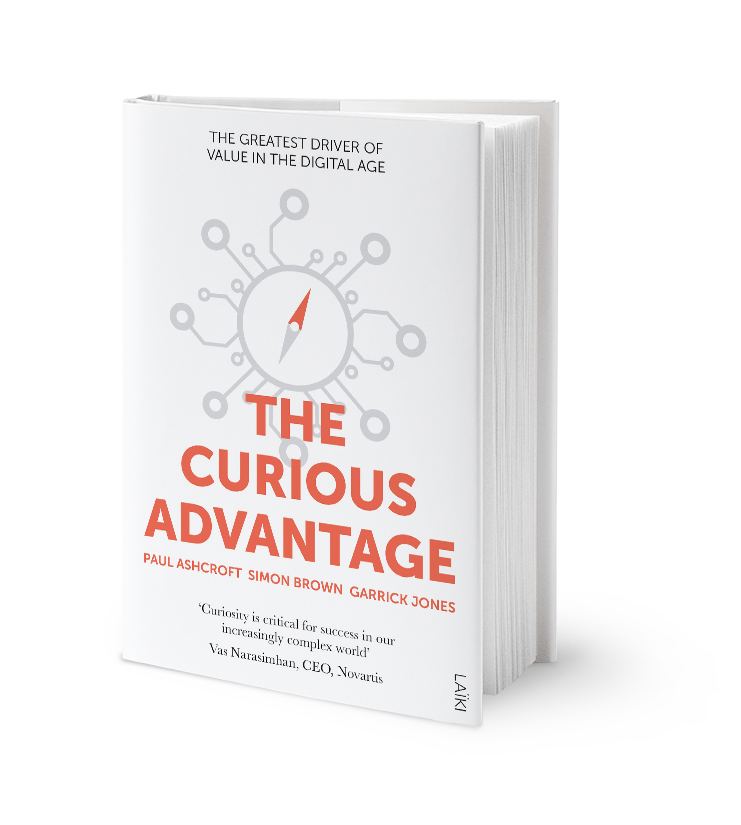
The Curious Advantage
The greatest driver of value in the digital age
The book that named the idea and set out the 7Cs — the model the new book builds on. Available in print, digital and audiobook.
Want the authors on your stage before launch?
Paul, Simon and Garrick are speaking on the ideas in the new book through the year.