

Episode 076 · Apr 15, 2025
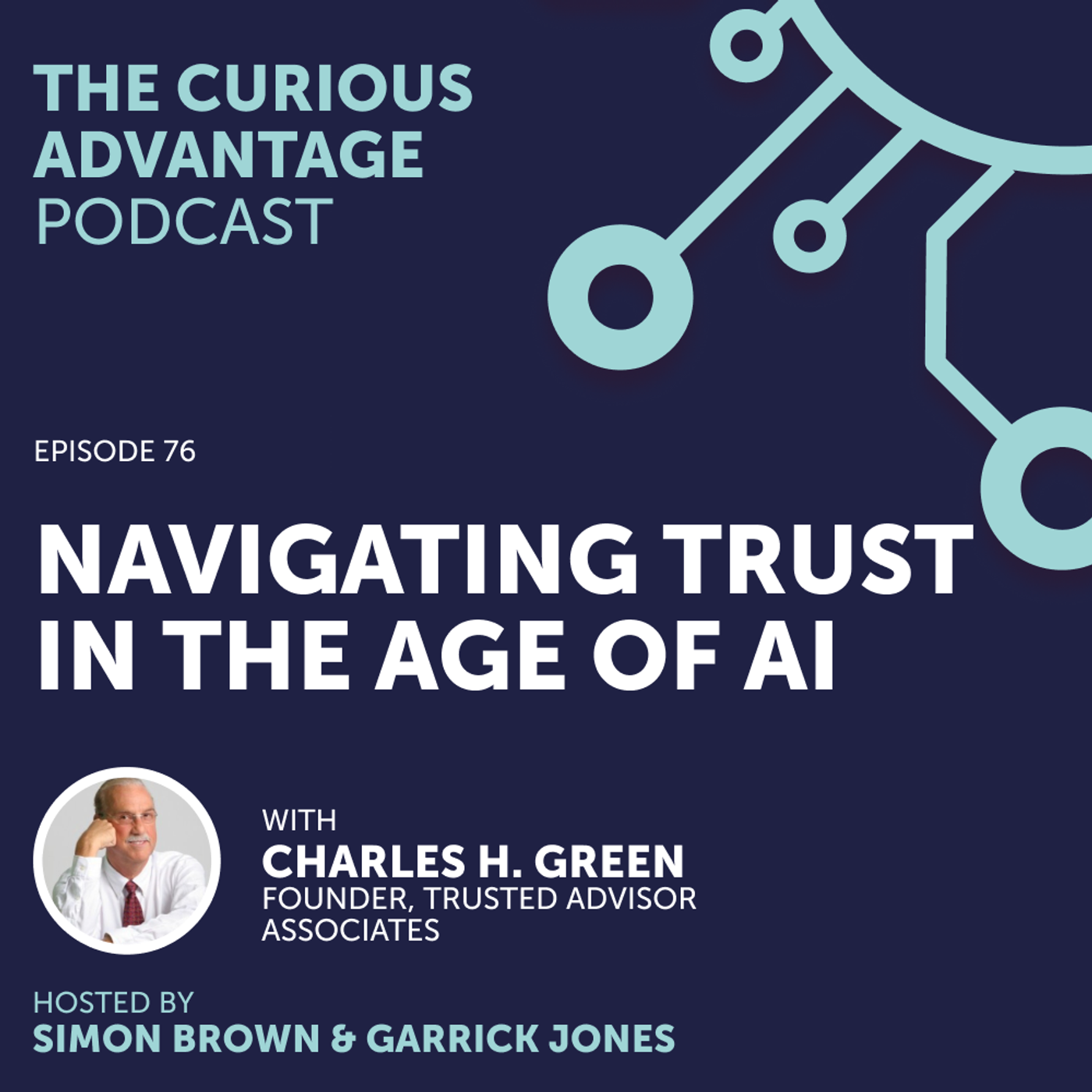
Charles H. Green: Navigating Trust in the Age of AI (Founder, Trusted Advisor Associates)

Transcript
Simon Brown06:23Hello and welcome to this episode of the Curious Advantage podcast. My name is Simon Brown. I'm one of the co -authors of the book, The Curious Advantage. And today I'm here with my co -author, Garrett Jones. Unfortunately, Paul can't be with us today. We're delighted though to be joined by Charlie H. Green. Hi, Charlie.
Garrick06:34Hi there.
Charles Green06:43Good morning, good afternoon. Nice to be here. Thank you.
Simon Brown06:46Thanks for joining us. A warm welcome to the Curious Advantage podcast. So Charlie, you're a speaker, executive educator, founder and chairman. You've authored three books, including the very well known Trusted Advisor and a real specialist around trust. So maybe if we could just start with, could you share a little bit on your career journey with us and how you ended up where you are today?
Charles Green06:50Thank you.
Charles Green07:10Sure. Well, let's see, I'm American, you can tell already. I grew up in the Midwest, went to college in New York City, majored in philosophy, ended up getting an MBA at Harvard Business School, and I spent 20 years in the management consulting industry, and then took a couple year hiatus to figure out what I wanted to do when I grew up. Ended up falling in with two friends, and we co -authored the book that you mentioned, The Trusted Advisor, that was back in 2001, I think. And of the three of us, I'm the one that said, gee, this idea has legs. Let me see where it goes. And over the next few years, I wrote a couple other books on the same general subject and founded this little firm called Trusted Advisor Associates. And fast forward, here we are today.
Simon Brown07:59So I think all three books have got trust as a theme throughout them. So what was it that resonated around trust? Why trust over all the other things that you saw in those 20 years as a management consultant? What was it that made trust resonate?
Charles Green08:13Right. Well, myself and my co -authors, David Mastrom and Rob Gelford, all of us had been consultants of some form or another. And as we glommed onto this idea of trusted advisor, it was a term that even back then had enough currency that you couldn't copyright it. So it was out there. Merrill Lynch was doing ads based on it. And we thought nobody's written a book about it. we had somebody else's model that we borrowed and tweaked. called the trust equation. We thought there's something here and we decided to write, in a way, write down all the mistakes and the horrible things that we did wrong as consultants so that nobody else would have to do them. We all believe that you learn more from failures than from reading successes. And we just built out the concept. So it was a little bit serendipity, a little bit gut feel. It was not a strategic decision. It just felt right.
Garrick09:09I'm interested in some of the concepts you've got around trust, Charlie, like the difference between interpersonal trust and institutional trust.
Charles Green09:18Yeah. That one, my point of view is that one I call thin trust and one I call thick trust. Institutional trust in my mind is thin trust. It carries some of the components of the broader definition of trust, but only a few of them. And those tend to be quantitative behavioral things like competence, reliability. but the deeper emotional components of trust really only show up in the interpersonal form of trust. And I think most of us walk around with an interpersonal trust model in our heads and we kind of apply that to institutions. So I view the interpersonal model as kind of more primary, more formal, more complex, more nuanced, and that's the one I tend to focus on. Not that I don't have things to say about institutional, but it's connected to that as well.
Garrick09:49Hmm.
Simon Brown10:13And we'll dive into those in a moment. You mentioned something in passing though that I'm curious to just quickly go back to, which was the trust equation. So I recall in the past having seen the trust equation, but take us through, Charlie, what the trust equation is and how we can, I guess, apply it.
Charles Green10:31All right, well, if you allow me to sort of pull back on that and give a bigger framework within which that fits. Anybody listening to this, you you see trust in the business press anywhere and it's pretty vague, squishy, fog sculpting, not very well defined. And as an undergraduate philosophy major, that always bothered me. So I've tried to come up with a very precise, common sense, logical.
Simon Brown10:38Perfect, please, yeah.
Charles Green10:59inclusive and exclusive notion of it. And here it is. The trust, the noun trust, is a name of a relationship between two parties. And those two parties have two distinct roles. There's a trustor and a trustee, one who does the trusting and one who is trusted. Now it goes back and forth, you know, between the parties, just like love or friendship, you know. But it's always, you're either playing one role or the other. You're either trusting or you're being trusted. If you're trusting, the key aspect to trusting something is risk. You know, it is a risk to trust somebody. If there's no risk, then it's not trust. Remember that old famous Russian proverb that Ronald Reagan made famous, trust but verify? No, that's not trust. That's a word game. So the essence of trusting is thinking about risk taking. The essence of being trusted, being trustworthy,
Garrick11:27Hmm.
Simon Brown11:45Yep.
Garrick11:52Hmm.
Charles Green11:52is a little different. And that's where we get the trust equation that comes into play. Four components, by our definition, it's not materially different from other models. There are many models out there, but in ours, it's credibility plus reliability plus intimacy, all divided by self -orientation. So C -R -I -S, credible, reliable, intimate, self -orientation in the denominator. And we can explore. each of those, the first two, credible, reliable, those are kind of the rational, behavioral, cognitive, quantitative kinds of components, the ones that most of us tend to focus on. The other two, the intimacy and self -orientation, those tend to be much more emotional, much more elusive when it comes to quantifying. And it turns out those are actually, you know, by some form of analysis, the more powerful and certainly the ones that are less discussed. and I think end up being very relevant to the way that I look at in the world. So trustors, trustees, trust is a result and if you want to diagnose a trust problem, you should start by saying does the problem lie in the trusting or in the trustworthiness? Which part, which one's lacking? And yeah.
Garrick12:50Yep.
Garrick12:57Mm.
Garrick13:04So can I just help me understand? It makes a lot of sense to me, the credibility plus reliability. And is that plus intimacy?
Charles Green13:10Yeah. Yep.
Charles Green13:15Yes.
Garrick13:17And then it's divided by self -orientation. And this is the question I have. Why is it divided by self -orientation? Self -orientation obviously has a huge impact on all three of those and possibly a negative impact if we're careful.
Charles Green13:20Right.
Charles Green13:31Yes it does.
Charles Green13:36Correct, that's why it's in the denominator, goes the other way. I mean, yeah, right, it goes, yeah. You know, the reason we did it that way, as I said, we inherited a form of that model, which used a numerator over divisor format, and I always was intrigued by it. And we changed one factor, added another, but we kept that numerator divisor factor, and the reason is very simple. You could have flipped the denominator and called it other orientation,
Garrick13:38Got it. I did do maths.
Garrick13:53Mm.
Garrick14:06Hmm.
Charles Green14:06and you would have had a model that said C plus R plus I plus O. But that's boring. mean, it would make people say, well, what about Q? What about R? Or why is one not redundant? This way, I find that people are naturally intrigued by an equation of that form, and it gets them thinking in ways that we never would have had it been a straight linear dynamic.
Simon Brown14:11I'm
Garrick14:23Mm.
Garrick14:30I have a question about why can we explore what is self orientation? How does self orientation affect credibility? How does it affect intimacy? And how does it reliability?
Charles Green14:34Yes? Yeah.
Charles Green14:40Well, how does it affect curiosity too, by the way? It's that. Yeah, yeah, well, let me that out. A very quick credibility is like expertise, competence, credentials, that sort of thing. Reliability is dependability, predictability. We all get those. Those are fairly self evident. Intimacy. A lot of my clients find, you know, they're politically incorrect. They don't like to deal with that. But I mean it in a very
Garrick14:44Very good. Yes.
Simon Brown14:45We'll go there in a minute.
Charles Green15:09intentional sense. It means, you know, the ability to be personal with somebody else, the ability to share things with somebody without fear that they're going to abuse your confidence. That's sort of a thing. An intimate relationship is one in which you freely share at a personal level with another person, know, issues of importance. Self -orientation, the one in the denominator, is about two things. It's about who you're focused on. and how much attention you're paying. If you're focused on yourself, that's called selfishness, that's a killer right off the bat. You know, it colors your motives for everything. If you have a high self -orientation, nobody's gonna trust you because you're in it for yourself. Fortunately, that's not a big deal usually in business. know, Bernie Madoff is no longer around and there aren't that many of him. The other form, self -preoccupation, constantly neurotically worrying about yourself is the most powerful form of self -orientation that we explore. if you're always worried about yourself, if you take every comment as being about you, it's kind of a narcissistic disorder, if you will, you're not able to pay attention to others, to listen to others, to ask genuine questions, you're not able to be curious.
Garrick16:26Hmm.
Charles Green16:27I view the ability to trust and be trusted is a precondition for curiosity. You can't be curious if you're neurotically self -obsessed all the time. that's how that rings with you guys.
Garrick16:41That's so true, honestly.
Charles Green16:44Yeah, so that's quickly what we mean by self -orientation.
Simon Brown16:45Yep.
Simon Brown16:48I that. So yeah, so if, and I presume because it's the denominator at the bottom that that can massively swing everything else. So if your self orientation is seen as strong, destroys everything, everything above the line.
Charles Green17:00Well, yes and no. Let's not get our maths degrees too exercised here. The fact is we laid it out that way, but if you examine it statistically, we did actually flip it in order to do a regression analysis and figure out which component was the most powerful by equally weighting them and analyzing them. And it turns out by a small margin, intimacy is the most powerful one, closely followed by self -orientation, and then a much lower reliability credibility.
Simon Brown17:19Yes.
Charles Green17:29So it's the two emotional components that really carry the most weight in a trust relationship.
Garrick17:36That's interesting. That really is.
Simon Brown17:38Just a quick pause, I was hearing quite a lot of loud pings on there, so I'm not sure, I don't know if it's coming through on your phone, Charlie, or somewhere, there was some sort of ringing notification things coming through, I don't know if anyone else heard that.
Garrick17:49Yeah, I heard that too.
Charles Green17:53I don't think it's coming from me, but.
Simon Brown17:56No. Or have we got any other? don't know. Okay, I'll make sure everything is muted this time. just in case it's coming from.
Garrick17:59I'm on a,
Charles Green18:04Let me turn off my phone just to make sure.
Charles Green18:11All right.
Garrick18:12And it...
Simon Brown18:12Cool. So diving into then the link between trust and curiosity. tell us more on how you see the relationship there, Charlie.
Charles Green18:22Well, you know, I haven't really thought about it that much other than, people often do ask me, you know, I come in a lot of podcasts like this and people say, well, what's your single best piece of advice? And I waver between saying, a better listener, which is, you know, kind of boring, but true. And cultivate an attitude of curiosity, which I view as much more interesting and really kind of profound. You want to be a trust advisor, cultivate an attitude of curiosity. It means you are other oriented.
Simon Brown18:39Yep.
Garrick18:43Mm.
Charles Green18:52It means you're self -secure enough in your own ego, in the good sense of the word, that you can afford to pay attention. You can get over your damn self and pay attention to others. So it's a virtue which requires a certain strength of personal inner strength in order to do it. And many good things come from being curious. Very few bad things come from it, and many good.
Simon Brown19:17And interestingly, if those are the two things of being a better listener and cultivating curiosity, some of the research we saw was actually that if you're curious, it actually makes you a better listener as well. So yeah, you actually pay more attention and you absorb more of what the other person says. There's research that backs that up as well. that's it. very good. Sorry, yeah, go on, Gareth. You go, you go.
Charles Green19:26I'm sure.
Charles Green19:34makes total sense to me.
Garrick19:38In your books, you do you have a follow up, Simon? Charlie, in your books, you mentioned that you can't have trust without connection. And that seems to be boiled up with your understanding of like intimacy and self orientation. And what is the biggest thing we can do to connect to somebody else? I mean, you talked about curiosity, of course.
Charles Green19:55Right.
Charles Green20:02Yeah. I think, you know, I would go to listening, paying attention, being curious, you know, if you want to connect with somebody, you're not going to do it on an institutional level. you work for Ernst & Young, you work for FedEx, you work for Microsoft. You're not going to do it on a cultural level. you're English, you're Australian, whatever. It's got to be at a personal level, which means you have to engage with them about, you know, who they are. who they see themselves as being. How do you do that? You pay attention. You ask interesting questions and you react to them and you share how it impacts you, how you feel about that. So a personal dialogue, I think, is at the heart of that kind of connection.
Simon Brown20:50There's a lot of research that shows that trust levels in wider society, whether that's in institutions, with governments, etc., are diminishing, which is a worrying statistic or fact to see. From all your work around trust, are there things that we can do to rebuild that trust or improve those levels of trust?
Charles Green21:13Well, first of all, you're absolutely right. They are declining. Every institution you can think of in most of the Western world has gone down in terms of perceived trust and so forth. They're broadly, let's take the corporate world, for example. Say you're running a big company and you want to increase the perceived trustworthiness of your company. There are broadly two approaches, and I think one of them is better than the other, and it's not the one that's most commonly used. The one that's most commonly used is you hire a PR firm, you blitz the communications out there, you get good advertising, you show up at various places of interest and you talk about how trustworthy you are, that sort of thing. That can move the needle, but it won't last very long if you can't back it up. If you tell people that you're trustworthy, mean, look in the States, we have this great example of Wells Fargo Bank, which for the last 10 years, has struggled to get out of the mire that it found itself in by some egregious violations of trust. And one of the first things they did was advertise, we don't do that anymore. Well, it turns out they did. There goes one CEO and then onto the next. So it's skin deep. It's a fast fix, but it's skin deep. The deeper solution is to start fixing the problem and wait on the communications.
Garrick22:23Hahaha. out.
Charles Green22:38So if you could imagine waving a magic wand and let's say suddenly everybody in Wells Fargo or whatever company you want to pick suddenly personally became very trusting and very trustworthy in all their interactions with all their people, with customers, with each other, with suppliers. How long would it take for the public to notice that they were dealing with trusting and trustworthy people? Depending on the business, not that long. four months, six months, eight months, two months, something like that. And that would be lasting. Now you can't wave a magic wand and do that overnight. It's a longer term cure. But I think that's the more powerful one. And it goes back to the notion of individual trust. An institutional one that you asked at the beginning. I may say, well, I trust FedEx to deliver my packages. But if they screw it up twice in a row, I don't trust FedEx anymore. On the other hand, just because I trust FedEx does not mean I trust the FedEx driver to babysit my granddaughter. However, if I trust the FedEx driver and I have some kind of relationship, you know, they know what time of day to deliver it, where on the porch to leave it, then I'm much more likely to trust FedEx as well. And that's a much longer -standing kind of a relationship. So my general prescription
Garrick23:42Yeah.
Simon Brown23:43Yes, and narrow trust limited to, yeah, they do.
Garrick23:59Mm.
Charles Green24:04is look internally, fix the people that are driving it because the primary driver of trust ends up being interpersonal anyway. And that will reflect on the institution. Rather than trying to solve the problem at the institutional level, which, you know, somebody once said, what's the saying, problems don't get solved at the level they're created? I don't know if that's applicable or not, but in this case, I think you don't solve institutional trust by working at that level. My opinion.
Garrick24:30Hmm.
Simon Brown24:31My sense is in the sort of digital world we have today with social media, with things like Glassdoor and Fishbowl and all of these other things that that first approach of a sort of the PR sort of try and gloss over something is a very, very short term view that the truth will very quickly out and it needs to be genuine, genuine change or yeah, glossing over something is yeah, it's hard to do I think today.
Charles Green24:52Yeah.
Charles Green25:00You know, interestingly, if I recall, the history of the public relations industry, there were two proponents of PR back in the 20s, 30s, I forget what. And one of them, I think was hired by Andrew Carnegie because they had some problems at Carnegie Steelworks. They had some strikers and he called in goons and they shot the strikers dead. So that's a PR problem.
Garrick25:23Yeah.
Charles Green25:26This guy came in and he said, first of all, no more shooting strikers dead. Let's start with that. Fix the plates so that can never happen again, and then we'll talk to the public. Well, his approach, sensible though it was, did not win out. And now the PR industry, of course, is totally focused on fix the external, fix the exterior, fix the communications first. You know, look at any big company you want, oil industry, all the scandals. You know, that's what we have.
Simon Brown25:32Yeah.
Garrick25:54It's interesting because that feeds into a question I have around people who are different from us. know, trusting people who are similar to us is something of finding intimacy, finding something we might have in common or being, you know, using inquiry or being open and curious with people. get that. What about if somebody has a completely different worldview from me, you know, whether it be in terms of religion or gender or culture or politics, what say there is a really different person with from somewhere else. How do I can I establish trust in a meaningful way?
Charles Green26:34Yeah, I think you can. I'm an optimist in that regard. I think what it does is challenge our ability to be curious, to listen, to understand as objectively as we can be. We all have our biases. We all have our habits. And many of them we're unaware of. I mean, from my own life, for example, I was married for seven years to a black woman from Queens, New York, and I'm a white kid from Nebraska. You know, it's very different. And I'll tell you, it was one of the biggest learning experiences of my life. We're still good friends.
Garrick26:55Hmm.
Charles Green27:02and just enormous amounts of learning. But I think we have to be good at recognizing our own biases, staying open to what we hear. But it's absolutely a worthwhile journey. I would argue that there's a lot more to be gained by all parties involved, learning about somebody who's different than there is learning about a clone of yourself. We already know that one.
Garrick27:22Hmm.
Simon Brown27:26So Charles H. Green is a speaker and executive educator focused on trust in complex businesses and professional services firms. And Charlie's the founder and chairman of Trusted Advisors Associates. In addition to the Trusted Advisors book, Charlie also wrote trust -based selling, and he also co -authored the Trusted Advisors Field Book. He's a graduate of Columbia and as we heard also Harvard Business School, and he spent the first 20 years of his career with the Mac Group and its successor Gemini User Consulting. So let's dive a little bit into your second book, Charlie, of trust -based selling. So you connect the concept of trust with sales. I think I can see there's a logical link there. So how does trust play a part in the sales process? How can you foster trust, I guess, in the sales process? And yeah, what was the hypothesis in your second book?
Charles Green28:05Yeah.
Charles Green28:18Yeah, well thank you for asking that question. It's probably my favorite book of the three. Also the least selling, but... A long time ago, and this came out of my experience as a consultant, hardly anybody in the consultative businesses at 19 years old said, I know what I want to do, I want to be a salesman. None of them. And yet, as you advance in the ranks, guess what? You have to sell.
Simon Brown28:26Hahaha.
Garrick28:26Hahaha!
Charles Green28:45Well, that causes psychological problems for everybody coming up the ranks in any large consultative organization, whether it's lawyers or accountants or consultants, whatever. we all have this, know, Gallup does a poll every year, most and least trusted professions. Salespeople are always at the bottom, know, bottom three. And I ask people on my webinars, you know, who do you put at the bottom? They always mention salespeople. So there's this pervasive cultural subconscious negativity towards sales, which can't help but infect everybody in the Western world. They all feel the same way. So you're faced with this conundrum. We find people who want to have high -minded, client -centric, customer -oriented views, and yet they feel they have to do this horrible thing called selling. among other things, it psychologically conflicts them. That always interested me and I've, know, throughout that book and thinking about it over the years, it's become kind of my favorite topic within the whole trust realm. And I'll sum it up this way. The problem with sales and the connection with trust is that from the outset, almost any sales training program you pick, almost any sales book you want to read has one overriding goal and objective, and that is to improve your ability to sell. Now think about that. That is right there, seller -centric. It is not buyer -centric. If your goal is to extract more money from your customer, guess who that's about? Talk about high self -orientation. At a conceptual institutional level, that's where the rot comes from in sales. And the answer is one of the wonderful paradoxes of life, just like happiness and a few other things. It comes about not...
Simon Brown30:11Mm.
Garrick30:18Hmm.
Garrick30:26Hmm.
Charles Green30:35by making it a goal, but by letting it be a byproduct. If you focus instead on helping your customers and your clients achieve what they want, guess what? That's who they want to buy from, people who help them. So you end up getting more sales by being 100 % customer focused, but don't ever let it become the primary objective. One of the old managing partners of Goldman Sachs, I forget his name, But he had this phrase, said, we are long term selfish. Yeah, we're in it for the money. We like it. We want to get rich. That's why we're in this business. But we recognize that every transaction, every quarter, if that's what we focus on, we're no good. We have to focus on helping our clients. And if we do that, we believe that we will become wealthy too. Well, he's right. Even though he's an investment banker, he's right about that.
Simon Brown31:28Hahaha
Charles Green31:29And so that to me is the interesting part of sales. And you can take that notion down into things. How do you handle objections? How do you handle pricing questions, pricing policy? How do you handle presentations, first meetings, decision making? I mean, here's a little model, for example. I would suggest there's a picture of meat sandwich. Whether you like meatloaf or pork sandwich or turkey, whatever. Two pieces of bread with the meat in between.
Garrick31:56Hmm.
Charles Green31:59And here's how that analogy applies. The bread are the beginning and the end of a sales process. The beginning is getting in the door. And you do that mainly through reputation and credentials. You know, I've written these books. We have this list of clients. You can look at all these testimonials. That will get you in the door. It won't get you the sale. You know, once you're in the door, you can't just keep piping your credentials. You have to do something. And let's say then jump ahead. Let's say they make a decision and they choose you. The other piece of bread refers to how they rationalize it. No client in the world is going to spend $100 ,000 to $1 million and say, well, we did it because, I don't know, we kind of like these guys. We sort of trust them. No. You get laughed out of the boardroom for that. What you do is say, well, we want them because they have a great track record and we did an analysis of the ROI and so did them. But the meat in the middle has nothing to do with that. The meat in the muddle in the middle is this emotional, non -rational feeling that we go through making up our minds, making a decision. And it sounds something like, you know, I'm not entirely sure these guys are terribly better, but I trust them to be honest with us and open. I trust them to hold to our goals. We don't need 100 page legal contract with these people. I think they're going to play straight with us. I think this is a good bet for us to do. Again, that's hard to defend in the boardroom after the fact.
Garrick33:08Mm. Mm.
Charles Green33:22but it is in fact how human beings, even in organizations, make decisions. So you have this meat sandwich with rational bread and non -rational meat in the middle. That's an example of thinking about how I think of trust and sales.
Garrick33:40That's fascinating. I have question about your thoughts on trust in artificial intelligence, especially regarding issues like deep fakes. I mean, there's a trust issue there, right? How can we determine what's real and trustworthy in your view in this new AI empowered digital world that we inhabit?
Charles Green33:51Ha ha ha! Yeah, yeah. yeah.
Charles Green34:04Yeah. Well, you're certainly right. And we're, you know, with the new AI stuff, we're seeing a whole new wave of this. I don't think it's fundamentally different than when we first had voicemail or email or some other technological evolution. I'm sure, you know, the early days of the telephone, somebody figured out, you know, fake phone calls or what we now call phishing. And it fooled a few people and it took a while. And now, you know, 10 years ago,
Garrick34:26Mm.
Charles Green34:31We had Nigerian princes emailing us saying, you know, I got $10 million for you if you just send me your credit card. And we've all pretty much gotten to the point where we can smell a Nigerian prince from, you know, even see him coming. I kind of think we'll get there too. I mean, over here recently, we saw somebody put out a deep fake of Taylor Swift endorsing Donald Trump. You look at that and you go, I don't think so. But here's this deep fake video. I think we're going to quickly get to the point where we say, no, it doesn't make sense. And maybe we'll see, we may see some technological, technical elements to be able to say, I know I'm to film her saying that, the camera is off, but it's not going to be the technical stuff that solves it. I think our common sense is going to catch up with it. So I don't think, if the question is, how do I know whether or not to trust a deep fake,
Simon Brown35:10you
Garrick35:19Hmm.
Charles Green35:26I don't think you're gonna find the answer technically. You're gonna find it in our cumulative experience that says, wait a minute, let's apply a does it make sense test here.
Simon Brown35:35So we have in our book, the seven C's of curiosity, and one of those is around criticality. And I think that's incredibly important with what we're seeing with some of the developments of AI, either through intentional, either deep fakes or there's various other things that you hear now, of audio, from a small clip of audio, you can replicate people's voice and things, and you hear of... people using that for scams where you get a phone call from your child and it's not actually your child or whatever. So I think there's that piece where that criticality piece of does this feel right? Does this fit with everything else I know the context I know is this right?
Charles Green36:05Right, right.
Garrick36:06Hmm.
Charles Green36:13Yeah. And there will always be con men, and there will always get some victims. I just think it's going to happen at a higher level of rationality here with AI than it has before, but it's not qualitatively different.
Simon Brown36:18Yep.
Simon Brown36:27And then there's the trust that comes out from the large language models as well with the hallucination and things where things, not from any malicious perspective, just the way that the models work, that they create something that looks incredibly convincing, but actually has been hallucinated and is not based on substance. yeah, I guess our ability to critically determine whether something is real or not is because it feels like it's to become increasingly important in a world.
Garrick36:29Hmm.
Charles Green36:33All right.
Charles Green36:45Great.
Charles Green36:55Yeah, I would think so.
Simon Brown37:00Overall, do you see that AI would make trust or will help or sort of hinder trust in society? Do you have a perspective around where you see it better or worse in the future as a result of a greater adoption of AI?
Charles Green37:14I don't have any great insight on that. expect it will lower it for a while anyway until we kind of catch up to it because the capabilities of AI are pretty astonishing. We haven't seen this before at this scale. So I think it'll take a negative hit for a while. But ultimately, I for example, I find it tremendously useful as a research tool. They're going to put Google Search out of business. I'm all ready.
Garrick37:21Hmm.
Simon Brown37:39You
Charles Green37:40I'm not using Google search anymore. I use one of the AI tools because it gives me sources. gives me much more. So that I think will help, know, help on some level.
Simon Brown37:49Absolutely. Yeah, I'm sure things like that of being able to go to the underlying source documents of where the data comes from will absolutely help in then establishing that. Coming to you personally then, Charlie, what are you curious about at the moment? yeah.
Charles Green37:58Yeah.
Charles Green38:06Good question. I am curious about AI. find that fascinating. Lately, I have started a... I mean, for many years when I was running trusted advisor associates, I wrote a blog and articles, maybe about thousand articles and blogs, mostly around trust. And when I semi -retired, I thought...
Charles Green38:32I'd like to write something that has a little bit more to do with the interpersonal aspects that have some overlap with trust, things that we've been talking about. So I've started a LinkedIn newsletter called Breaking Good, like Breaking Bad, you know, the TV show Breaking Good. And it's about tales of inspiration and insight and, you know, little moments or big moments of people in business, sometimes not in business, who have like epiphanies.
Simon Brown38:47you
Charles Green39:02or who do something outstanding when you think about it. People that get over resentment. There's one I wrote about a woman whose spouse was unfaithful and she got over it in a week. What you think, wait a minute, that's not credible. Well, it is. I actually know the person. She legitimately figured out a way to process and accept and move forward with her husband in a positive way.
Garrick39:29Hmm.
Charles Green39:29And asked her at the time, said, just let me check that this is for real. What if he cheated on you again? And she said, I'd be out of here in a minute. You only get one chance with me. That's just one example. People that do extraordinarily psychological things that we think of almost superpowers, if you will. So that's an area of interest, exploring more of the interior struggles that we all have. And I guess that's about it.
Garrick39:38Hmm
Simon Brown39:59Yeah. Well, we're coming towards the end of our time. So we've had a great conversation. Some of the things I've been scribbling notes down, summarize our conversation. So we've gone through your, your background from management consulting and how you then wrote the trusted advisor, how you saw that actually it was an idea with legs and that actually you could go on and dive deeper into trust. We went into the trust equation and understood a bit about the different elements of trust where we have the trust or, and the trustee. the element of risk around trust and becoming trustworthy. And then the trust equation being credibility plus reliability plus intimacy, all divided by self -orientation. So one for us all to think about of how actually we can create trust. We heard about becoming a better listener and cultivating an attitude of curiosity. how when we think about trust, there's both at its personal level and an institute level, but really it's at the personal level where it's really most powerful. And then dived into the declining level of trust in society.
Charles Green41:02Yeah.
Simon Brown41:08what people can do when there is declining trust. So there's the short -term fix of hire a PR firm or the deeper solution of actually fix the problem. And I think we're all in agreement that the first one is probably not really a viable solution for the long -term. Dived into then trust and sales and learned about the meat sandwich. So with the bread being the beginning and the end of how we rationalize it, the meat being the trust, the emotional,
Charles Green41:16Yeah.
Garrick41:22Hmm.
Charles Green41:23Right.
Simon Brown41:37piece that sits in the middle and then into trust in AI and whether it's hallucination or deep fakes, but yeah, what the impact of AI is going to be or what trust, yeah, AI will do for trust. So lots there. If there was one thing, Charlie, for our listeners to take away from all of that, what would be your parting words?
Charles Green41:43Yeah.
Charles Green41:58Well, I'll tell you what, before this conversation, I didn't have an answer to that. But now, just given the dialogue we just had, here's what I would say. I work mostly with professional people, largely in intangible services and B2B sales. And a question a lot of them have is, how can I affect the institution? How can I do something? And my suggestion is always work on yourself. Start with yourself. much of what I've talked about doesn't have to wait for your boss's permission. It doesn't have to wait for there to be a corporate initiative. You can do this stuff right away this afternoon by yourself. You don't need permission for anybody and you don't need much training. We all get the kind of stuff that I've been talking about. It's innate, commonsensical. Trust your gut. So I guess the message I would be, was it Gandhi or somebody who said, be the change you wish to see in the world? Who was it that said that?
Garrick42:53I think Gandhi said that.
Simon Brown42:53Yeah, yeah.
Charles Green42:55It's a great saying. think we underestimate the power of personal agency and willingness to do the right thing. It ends up being a role model for other people. It gives other people courage. So don't bemoan the state of the world. Fix the piece of the world that you touch. Which is, in the end, pretty much all you can do anyway. And let the world take care of itself. Do the best you can do to be the best you can be.
Garrick43:12Hmm.
Garrick43:19Hmm.
Charles Green43:25That would be my message based on our discussion here today.
Simon Brown43:28love it. yeah, start with yourself. There's no reason not to get started. And yeah, be the change you want to be in the world. Absolutely. Charlie, thank you so much for a great conversation.
Garrick43:32Hmm.
Charles Green43:32Right.
Charles Green43:40thank you. It's been a pleasure. Really appreciate it.
Garrick43:41Thank you, Charlie. I tell you what, I always trust Simon to do an amazing wrap up. He's such a great ability to synthesize, but thank you, Charlie. That was amazing.
Charles Green43:46It is. With reason, yeah.
Simon Brown43:47you
Charles Green43:54Delight pleasure.
Simon Brown43:54thank you. So you've been listening to a curious advantage podcast. So we're always curious to hear from you. So if you think there was something useful or valuable from our conversation today, then please do write a review for the podcast on your preferred channel and say why this was so and what you've learned from it. We always appreciate hearing our listeners thoughts and having a curious conversation. So use the hashtag curious advantage. A curious advantage book is available on Amazon worldwide. If you want to dig deeper into our seven seas model for being more curious. So order your physical, digital or audio book copy now to explore how you can build your curiosity muscle. Subscribe to the podcast today and follow the curious advantage on LinkedIn, Instagram and YouTube to keep exploring curiously. Thanks very much and see you next time.
Charles shares insights on the trust equation, which includes credibility, reliability, intimacy, and self-orientation. The conversation also delves into the implications of trust in sales, the impact of AI on trust, and the importance of personal agency in fostering trust and connection in a rapidly changing world. They also discuss the growing presence of AI-generated scams, deep fakes, and the challenges these pose to building and maintaining trust in the digital age.
Chapters
00:00 Introduction to Trust and Curiosity
18:13 The Trust Equation Explained
24:30 Trust in Sales: The Meat Sandwich Model
33:40 Trust in the Age of AI
41:58 Personal Agency and Change
Join the authors of The Curious Advantage in an exploration of how individuals and organizations can harness the power of curiosity to drive success in our new digital reality. In each episode, they engage in enlightening conversations with world-leading experts from a diversity of disciplines to bring to life the latest understanding of curiosity in a way that’s useful to anyone looking to embark on a journey of discovery, navigate challenges, and unlock opportunities.
About The Curious Advantage Book
The Curious Advantage is an exploration of the idea of Curiosity and its increasing importance for thriving in the digital age. Taking the widest possible exploration of things Curious – historical, contemporary, neuro-scientific, anthropological, behavioural, semantic and business-focused. At the heart of the book is our model of Curiosity, called ’Sailing the 7C’s of Curiosity’. This model provides individuals with a practical framework for how to be successfully Curious and use Curiosity as a power skill to unlock their own potential. To find out more visit: curiousadvantage.com
Get your copy of The Curious Advantage on Amazon
The Curious Advantage Audiobook is also available on Audible
Follow The Curious Advantage on LinkedIn and Instagram
The Curious Advantage Podcast is executive produced by Jessica Wickham and Aliki Paolinelis. Audio editing is expertly by Danny Cross. Video editing by Jessica Wickham and John McGinty.
Listen and subscribe